Black Seed Launch · Email #5 · VALUE · Mon Aug 3
Seven Bottles of the Same Oil
Value email plus the full companion blog. A lab measured seven bottles of the same product and the results were nowhere near each other. The email delivers that gap and holds the explanation for the page.
The Email · 247 words
Hey {{ first_name }},
This is something you need to hear directly from me.
Last Thursday I told you our standard was black seed tested for thymoquinone in the finished bottle. Any brand can write that sentence. Meaning it is the expensive part.
In January 2025, ConsumerLab bought seven black seed oils and measured the thymoquinone in each one. Thymoquinone is the compound nearly all of the research on this seed is built around.
- The strongest bottle held 77.5 mg of thymoquinone per serving.
- The weakest bottle held 2.7 mg, which is 96% less than the strongest.
- Two of the seven held less than their own labels claimed. One held 42% of what it promised.
Both bottles say black seed oil on the front. Neither one shows you the number, and the clerk cannot tell you either.
I assumed the category drifted this far because somebody was breaking a rule. I was wrong. What is actually going on is worse, and it is the part I cannot let go of. You can check it yourself.
SEE WHAT THE LAB FOUND IN SEVEN BOTTLES →When this opens, the founding group goes first, and the list closes that same day.
PUT MY NAME DOWN (FOUNDING LIST) →Nothing to buy today. This only decides who goes first.
Reply if this landed. I read every one.
To your health,
Antonio
CEO, Black Forest Supplements
P.S. Friday I show you what we built, and every choice in it traces back to one of the numbers above.
The Blog · full draft · 2,025 words · 7 images
Seven Bottles of the Same Oil
A lab bought seven black seed oils and measured what was actually inside them. The results were not close. This is why nobody caught it, and why nobody had to.
By Antonio · Black Forest Supplements
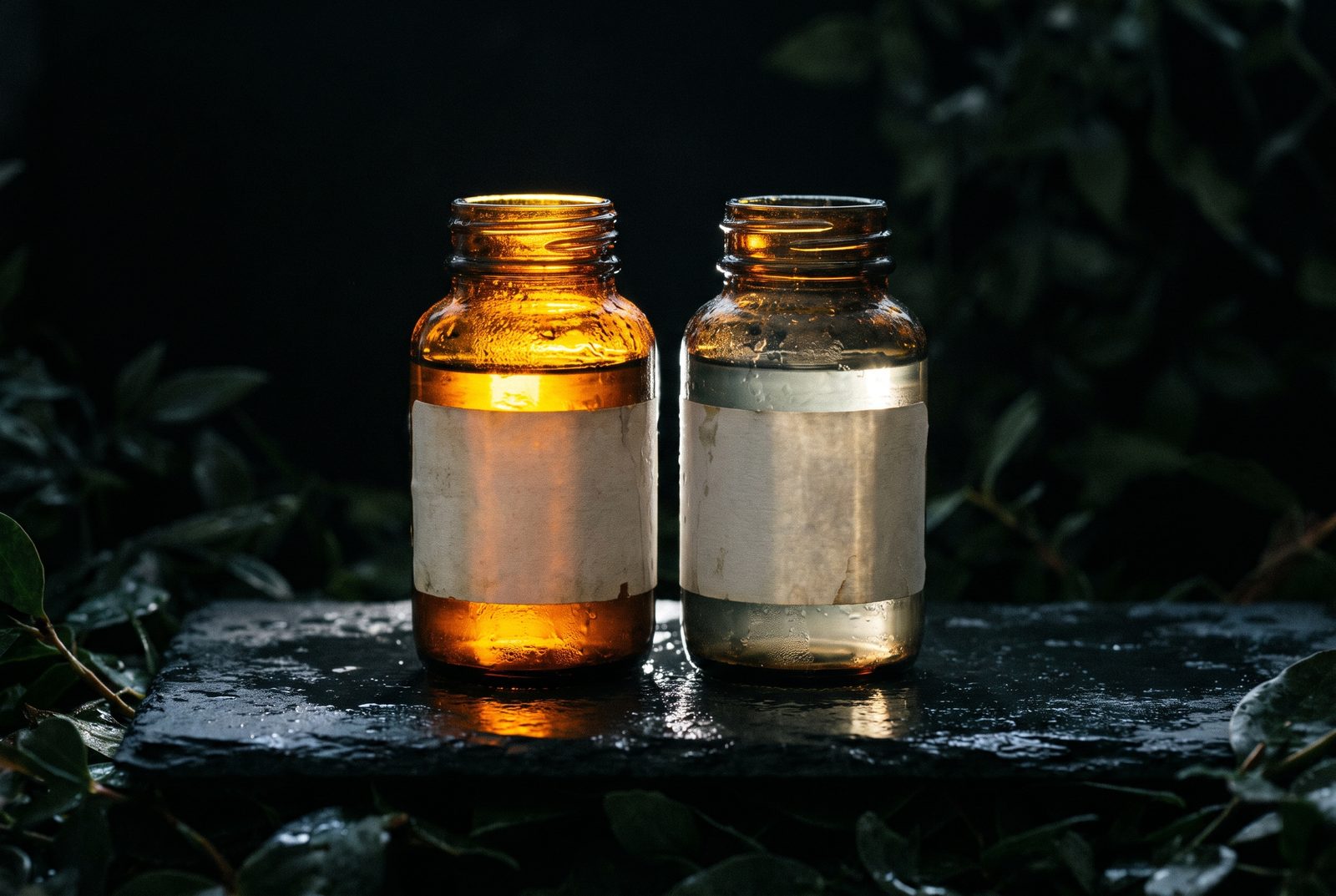
Alt text: Two identical backlit amber bottles, one dense with gold oil and one nearly clear
Two people buy black seed oil on the same afternoon in different cities. The bottles make the same promise on the front. They sit at close to the same price.
One of them takes home 77.5 milligrams of the active compound per serving. The other takes home 2.7 milligrams. That is 96% less, out of a bottle making the same claim.
Both of those numbers are real, and a lab published them in January 2025. Neither shopper will ever learn which bottle they carried home. The label does not print the number, the store cannot look it up, and no rule anywhere required a single person in that supply chain to check.
What the lab actually measured
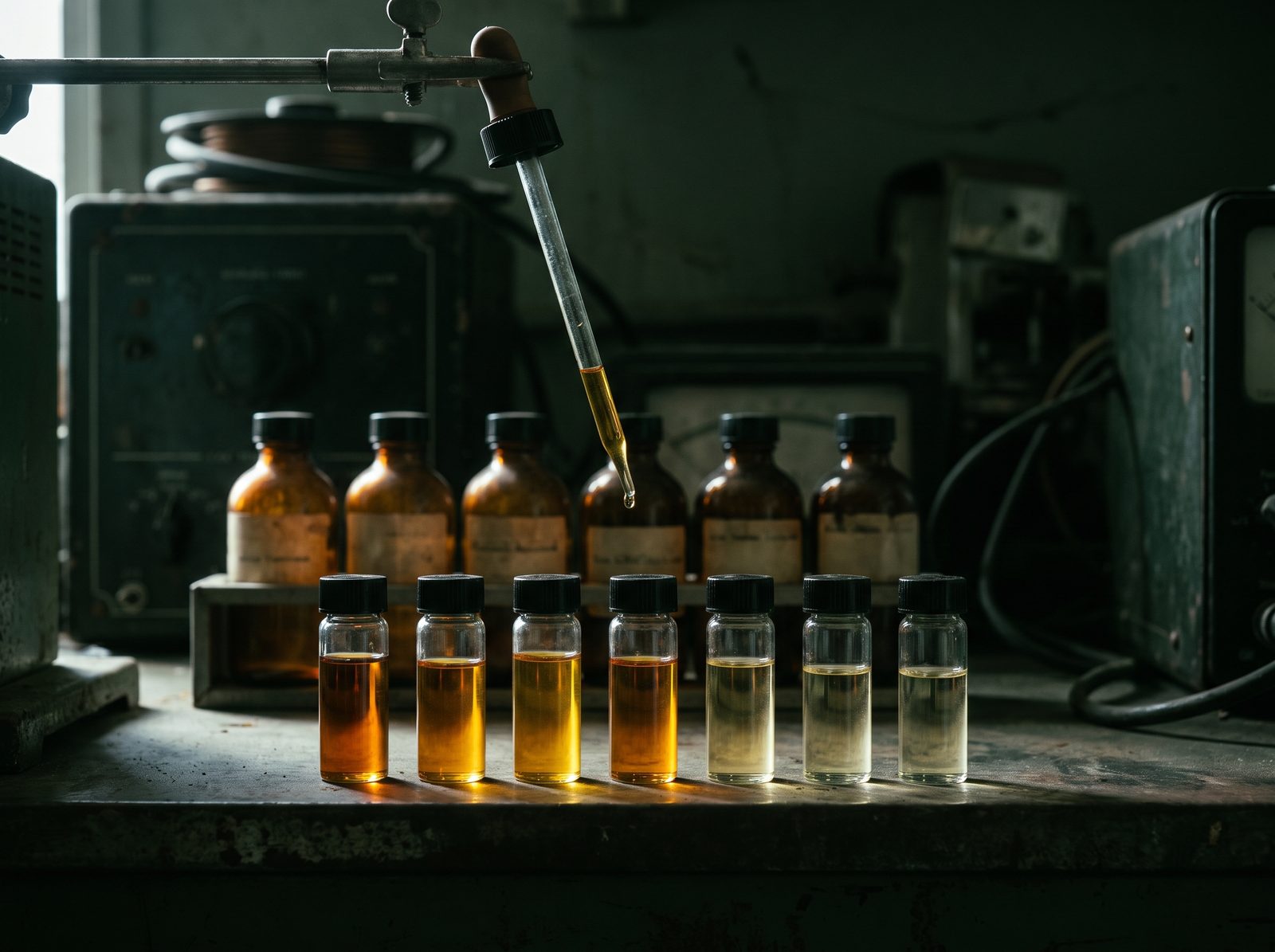
Alt text: Seven sample vials in a row grading from deep amber to almost colorless
In January 2025, the independent testing service ConsumerLab bought seven black seed oil products the way a shopper would and measured the thymoquinone in each one.
Thymoquinone is the part of the seed that the research is about. When a study reports something interesting about black seed, thymoquinone is almost always the compound doing the work. It is also the part that is easy to lose. It sits in the oil in tiny amounts, it breaks down when it meets heat and light, and it cannot be seen or tasted by the person holding the bottle.
Here is what seven bottles of the same product looked like from the inside:
- The strongest product carried 77.5 mg of thymoquinone in a serving (ConsumerLab, January 2025).
- The weakest carried 2.7 mg, which is 96% less than the strongest.
- Two of the seven held less than their own labels claimed. One of them delivered 41.8% of what it promised, so a shopper following the label got about 42% of what they paid for.
Nothing in that list is illegal. That is the part worth sitting with.
It was not one unlucky test
If this were a single bad sample, it would be a story about one company. It is not.
In 2022 a research group published a screening study in the journal Nutrients that did the same exercise on a larger scale, measuring thymoquinone across eleven commercial black seed products: six bottled oils and five capsule products.
- Thymoquinone content ran from 3.08 to 809.4 mg per 100 g of product, so the weakest product held 99.6% less than the strongest (Nutrients, 2022;14(17):3501).
- Even the strongest of the eleven was only 0.81% thymoquinone by weight, which is the whole problem in one number. The compound the research is built on is under 1% of what is in the bottle, so small losses in handling erase most of it.
The authors did not soften their conclusion. They wrote that black seed products "should be regulated regarding TQ content to enable consumers to buy black seed food supplements of known content."
That is a group of researchers, in a peer-reviewed journal, asking for the exact thing a shopper assumes already exists.
Why this oil, of all oils
Alt text: Hot oil running from an industrial press beside scorched black seeds
Follow one bottle backward and you can see where the number goes missing.
It starts in a field, where the amount of thymoquinone in the seed depends on the variety planted, the soil, the weather that year, and when it was harvested. Two honest farms can hand over two different seeds.
Then the seed gets pressed. Press it fast and hot and you get more oil per ton, which is what a buyer paying by volume wants. Heat is also the thing thymoquinone survives least well, so the cheapest way to press is the fastest way to destroy the reason anyone wanted the oil.
Then it sits. In a drum, in a warehouse, in a truck, in a bottle, in a store, in a cabinet. Every week of that is a week of exposure.
And at every one of those steps, a cheaper liquid waits that looks identical. This is where the economics turn ugly, because the oils used to stretch black seed oil cost only about 3% to 10% of what the real thing costs. A clear, faintly dark, oily liquid is the easiest product in the world to quietly dilute.
The fraud is documented, not theoretical
Alt text: Pale filler oil poured into dark oil, the boundary still visible
I am not guessing about the dilution. In September 2022 the Botanical Adulterants Prevention Program, a joint effort of the American Botanical Council, the American Herbal Pharmacopoeia and the University of Mississippi's National Center for Natural Products Research, published a bulletin devoted to this one crop.
It names the oils used to cut black seed oil: palm, corn, sunflower, soybean and canola. It reports that whole black seed gets padded with the seed of a different plant, Nigella damascena, which is close enough in size and color to pass a glance. And it says plainly that some products on sale contain no black seed content whatsoever.
- Those filler oils cost roughly 3% to 10% of what real black seed oil costs, which the bulletin names outright as the financial motivation for the fraud (BAPP bulletin, Orhan, September 2022).
To be fair to the bulletin, it does not claim to know how widespread this is, and neither do I. Nobody is counting. Nobody is counting, and the fact that nobody is counting is part of the problem.
Even an honest bottle fades
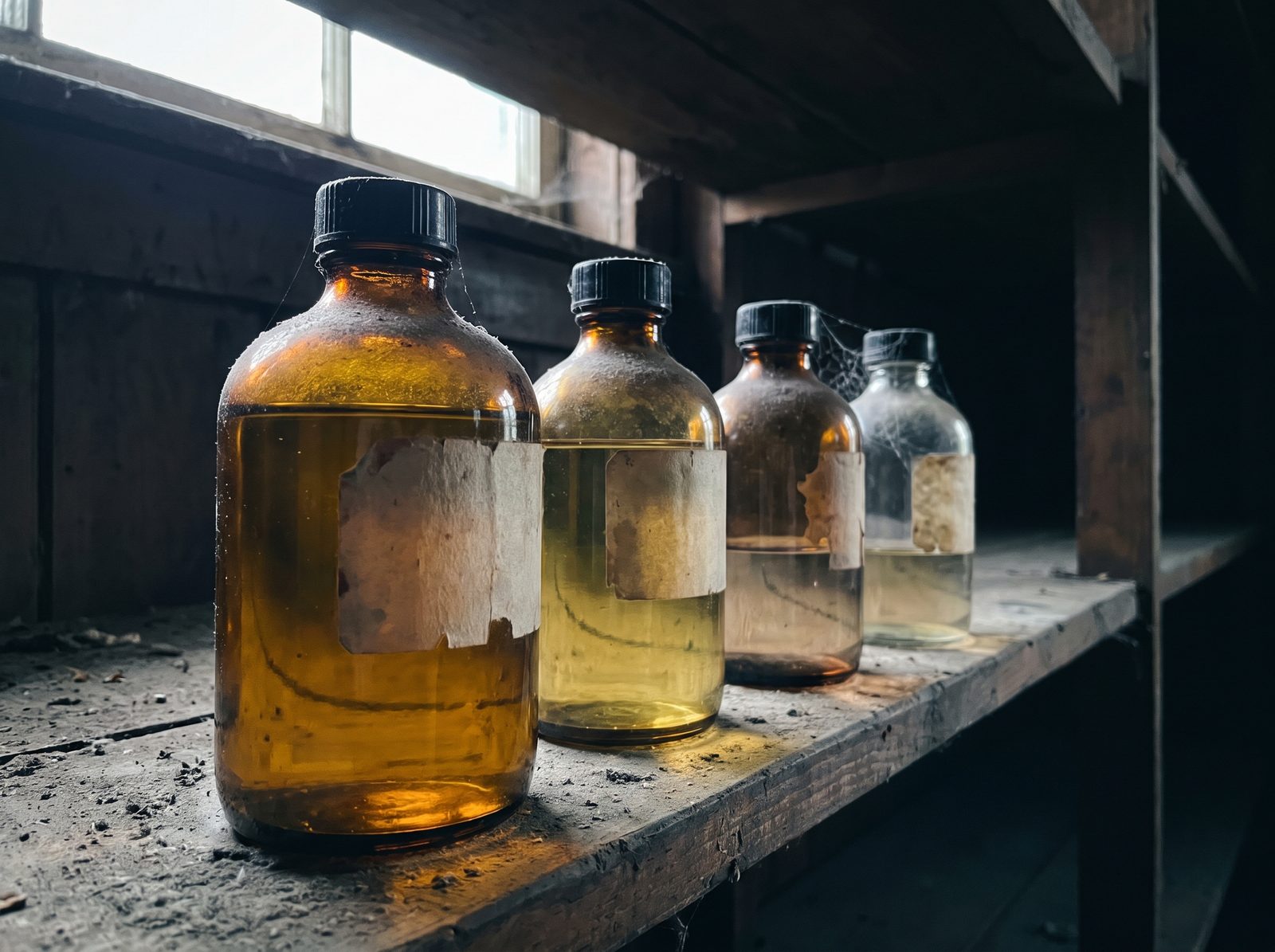
Alt text: Four identical bottles receding on a dusty shelf, the oil paling with distance
Suppose the farm was careful, the press was cold, and nobody diluted anything. The number still moves.
A 2023 study in Plants followed cold-pressed black cumin oil through four months of storage and tracked what happened to it. The oil's acidity climbed from 10.26% at extraction to 16.96% after four months, and measurable changes had appeared in its peroxide levels and even its smell (Plants, 2023;12(6):1351).
That test was run at 4 degrees Celsius. The oil was refrigerated the entire time, and it still drifted. Your bottle was not refrigerated on the truck.
So the number printed at bottling, if it was ever measured, is not the number in the bottle you open in month nine. Any test that means anything has to happen on the finished, filled bottle rather than on a drum of raw oil that has not yet had its hard months.
The part that changed how I saw it

Alt text: An empty stool at a dust-covered inspection bench, the instrument powered down Retry note: Hardest concept in the set and the most likely to need retries. If Gemini populates the frame with a person, add: absolutely no people, no figures, no hands, no silhouettes anywhere in the image.
I went into this assuming somebody was breaking a rule. Some corner being cut, some inspection being dodged, some line being crossed by people who knew better.
I was wrong, and the truth is worse than the version I had in my head.
Under the law that governs this entire category, the Dietary Supplement Health and Education Act of 1994, no supplement needs approval before it goes on sale. There is no agency reading the file and signing off. A company can formulate a product on Monday and sell it on Friday, and the first time any regulator looks closely is usually after somebody has already been hurt.
Manufacturing rules do exist, and they require a company to set specifications and confirm it hit them. Read that sentence carefully, because everything lives in it. The company sets its own specification. Nothing obligates that specification to include thymoquinone at all. A brand can declare "1,000 mg black seed oil" on the panel, verify that there is a gram of oil in there, and be entirely in compliance while having never once measured the compound the customer is buying the oil for.
And if a company does measure it, nothing requires them to show you. A Certificate of Analysis is a document you have to know to ask for.
So the honest description of this category is not that the rules are being broken. It is that the law makes each company its own examiner, never requires the exam to cover the thing that matters, and never requires anyone to publish the grade.
It is not a conspiracy. It is worse than one, because a conspiracy needs people to cooperate. This needs nobody to do anything at all.
This is bigger than one oil
If you think a gap this size would surely get caught by somebody, the record does not support the optimism.
- In 1977 the first federal dietary goals were softened after industry pressure, and in the decades that followed obesity and type-2 diabetes both doubled.
- Artificial trans fats were linked to an estimated 250,000 heart attacks and 50,000 deaths a year in the United States, and were not removed from the food supply until 2018, more than 25 years after the evidence was solid. The removal is projected to prevent roughly 90,000 deaths a year.
- When researchers went back and bought supplements the FDA had already recalled for containing banned pharmaceuticals, two thirds of the ones still for sale six months later were still adulterated (Cohen et al., JAMA, October 2014, 27 products tested).
- In 2015 the New York Attorney General had store-brand herbal products from four national retailers DNA tested. Only 21% of the results confirmed the plant named on the label. At one retailer, 4% did.
Two honest notes on that last one, because I would want them if I were reading this. The DNA method used has real limits on heavily processed extracts, and the industry said so loudly at the time. And Cohen's team tested 27 products, not thousands. Neither finding is the whole picture. Both tell you the same thing about how long a problem can sit in plain view before anyone with authority moves.
What you can actually do about it
Alt text: One hand offering a single sheet of paper across a dark counter to another
This is the part I would want handed to me, so here it is with no product attached.
Stop reading the front of the bottle. The front is marketing and it is the least regulated surface on the package. Turn it around and read the panel, and notice whether the compound you are buying the product for appears there as a number at all. For most black seed oils, it does not.
Then ask the company one question: can I see a Certificate of Analysis for the finished bottle, not the raw batch? That single sentence does more work than any label claim. A company that tests and publishes will send it without hesitating. A company that does not test will change the subject to how premium their sourcing is. You will learn what you need to know from which reply you get.
Ask it of us too. That is the only version of this that is worth anything.
What we owe you
I am not going to use an article about verification to sell you something unverified, so this section is deliberately the shortest one here.
We decided to hold ourselves to the standard this article argues for: whole seed rather than mystery oil, a cold press to protect the compound instead of a hot one to maximize yield, identity confirmed on the seed we actually buy, and thymoquinone measured and declared as a number a customer can read. Tested on the finished bottle, because that is the only test the storage data respects. And published, because you should not have to take our word for the number.
There is nothing to buy today. Nothing is named and nothing is priced. The door opens next week, and when it does the people on our founding list go first, and that list closes the same day it opens.
You should be able to know what is in the bottle. That should be the floor of this industry rather than something a brand gets to advertise as a virtue. Until the law agrees, the only protection you have is asking the question, and the only thing we can do is answer it in writing.
One more thing before you go. Everything above is about measuring what is already in the bottle, and a measurement is only worth something if somebody acts on the result. On Friday I will show you what we built with these numbers in hand. Until then, the question in the section above works on any bottle you already own.
Sources
- ConsumerLab, black seed oil product review, January 2025. Thymoquinone 2.7 to 77.5 mg per serving across seven products; two of seven under-labeled; one at 41.8% of claim.
- Screening of Thymoquinone Content in Commercial Nigella sativa Products. Nutrients, 2022;14(17):3501. Eleven products; 3.08 to 809.4 mg per 100 g.
- Orhan N. Adulteration of Nigella (Nigella sativa) Seed and Seed Oil. Botanical Adulterants Prevention Bulletin, ABC-AHP-NCNPR Botanical Adulterants Prevention Program, September 2022.
- Quality Changes of Cold-Pressed Black Cumin, Safflower and Milk Thistle Seed Oils during Storage. Plants, 2023;12(6):1351. Acidity 10.26% to 16.96% over four months at 4 °C.
- Cohen PA, Maller G, DeSouza R, Neal-Kababick J. Presence of Banned Drugs in Dietary Supplements Following FDA Recalls. JAMA, 22 October 2014. 27 products; 66.7% still adulterated.
- Office of the New York State Attorney General, press release, 3 February 2015. DNA testing of store-brand herbal supplements at four national retailers; 21% of results verified the labeled plant.
- Dietary Supplement Health and Education Act of 1994; FDA current good manufacturing practice regulations for dietary supplements, 21 CFR Part 111.
- US Food and Drug Administration, final determination on partially hydrogenated oils, 2015, compliance date 2018.
These statements have not been evaluated by the Food and Drug Administration. This article is about product quality and labeling, and no product mentioned is intended to diagnose, treat, cure or prevent any disease. It is not medical advice.
Audit · the email
9.5 / 10 on copy · 2 external gates open
| Lens | Score | Note |
|---|---|---|
| 4A Sequence | 10 | Industry problem first, no SKU named, offer withheld, correct rung of the value ladder. |
| 4B Subject mechanics | 10 | Four words, personalized, no caps, emoji, question mark or discount. |
| 4B Subject strategy | 9 | Broad emotional open loop with no topic label to skip on. Body honestly pays the loop off. |
| 4C Body | 10 | Full sentences throughout, one to three sentences per paragraph, weakness-first admission ("I was wrong"), real reframe. |
| 4D CTA | 10 | Two CTAs, which our data puts at 2.0% CR against 1.7% for one. Both promise information rather than labeling a topic. Both baked into the image. |
| 4E Urgency | 9 | One real scarcity line, stated once, and it is true: the founding list closes on open day. |
| 4F Voice | 10 | No conspiracy framing, no politics. "Nobody is breaking a rule" is the opposite of conspiracy language. |
| 4G Value template | 10 | 247 words, inside the 100 to 250 band that carries our best click rate. Our own teardown puts body length at r=+0.13, effectively null. |
| BVG 13-point | 13/13 | Humanizer run and passed (#11). Zero em-dashes (#12). One signature structure and zero negation triplets (#13). |
| Deliverability structure | 10 | Wrapper intro is the GlockApps-validated line at 91% to 92% inbox and carries zero campaign content. CTAs inside the image, image clickable. |
| Brunson Hook / Story / Offer | 9.5 | All three legs load. The hook stops the scroll without naming the topic, the story withholds its own resolution, and the offer promises the lab. |
| Epiphany Bridge | 10 | The email walks the reader to the edge of the epiphany and stops. The far side is on the page. |
| Attractive Character | 9 | Reluctant Hero: an admitted wrong assumption, a stated cost ("the expensive part"), and something he cannot let go of. |
| Soap Opera position | 10 | Closes #4's promise and opens a fresh loop into #6 on sourcing. Every email hands off to the next. |
| CTR drivers (18-send teardown) | 9.5 | Promise-type CTA, named institution, time marker, threat-exposé archetype, unlinked deferral. Five of five levers set correctly. |
| Readability | 10 | Ratios stated as percentages, never multiples, in both the email and the blog. Lab findings are bullets, each a full sentence carrying its own number. |
| Blog · Antonio 4 gates | 10 | Thymoquinone anchored in plain language on first use. Opens on stakes in three paragraphs with no editorial preamble. Mechanism runs as a story (one bottle followed backward from field to cabinet) rather than a list. |
| Blog · citations | 10 | Eight sources, all verified against primary sources, inline plus a Sources list. Two unverifiable figures cut rather than shipped. |
| Blog · product-free discipline | 9.5 | No SKU, no dose, no price, no buy link. The seed is named, which is correct from #3 onward; the product stays withheld for #7. "What we owe you" is deliberately the shortest section. |
| Compliance and self-implication | 9 | Frame is accuracy, not potency. Remaining rows are all gated on the COA. |
Audit · the blog · Brunson and Soap Opera Sequence
9.0 / 10
| Lens | Score | Note |
|---|---|---|
| Hook | 9.5 | Two shoppers, a 96% gap and "neither shopper will ever learn which bottle they carried home" inside the first 90 words. A clock now sits in the opening paragraph, which the 18-send data ties to 0.85% against 0.665% for the five sends that opened with no time marker. |
| Story · Epiphany Bridge | 9 | All six beats run in order: the false belief (somebody is breaking a rule), the wall, "I was wrong," the new frame (the company is its own examiner), the new opportunity (ask for a COA), the framework. The emotional temperature is more outrage than personal loss, which is the one thing keeping it off a 10. |
| Domino Statement | 10 | One belief carries the whole piece: nobody is required to check the thing you are buying. Accept it and every later objection about price or proof answers itself. This is the strongest structural element in the article. |
| New Opportunity vs Improvement | 10 | Verification is framed as a different category standard rather than a better version of the same thing. Brunson's distinction, and the piece stays on the right side of it. |
| Breaking and rebuilding belief | 9.5 | "I went into this assuming somebody was breaking a rule. I was wrong" breaks the reader's frame using the author as the one who held it, so nobody gets called naive. |
| Attractive Character · Reluctant Hero | 9.5 | Admitted wrong assumption, stated cost, something he cannot let go of, and "Ask it of us too," which turns the standard back on the author. Identity and flaw both present. |
| Polarity and enemy | 10 | The enemy is a named legal structure (DSHEA plus self-set specifications), not a cabal. The article explicitly refuses the conspiracy frame, which is also the compliance-safe position. |
| Offer | 9 | The founding list, with real scarcity. The close now carries "The door opens next week." On an identical 15k list the 1.344% winner had a settled fact with a date and the 0.719% laggard had none, 1.87x apart on the same button, so this was the weakest link before the fix. |
| SOS · position in sequence | 10 | Occupies the SOS epiphany slot and pays off #4's promise. Reader arrives owed an explanation and leaves with one. |
| SOS · hidden benefits | n/a | Deliberately absent. That is SOS beat four and it belongs to #6, not here. Both frameworks and our own decay data agree on this, so it is a sequence assignment rather than a gap in this piece. |
| SOS · forward loop | 9.5 | The article now ends by naming the question it did not answer and pointing at Wednesday. Before the fix only the email P.S. carried a loop, so anyone landing from social or search hit a dead end. |
| CTR levers from the 18-send teardown | 9 | Four of five verified levers set correctly: promise-type CTA, named institutions throughout, threat-exposé archetype, unlinked deferral. The fifth is stat density, which measured null, and this article is the most stat-dense thing in the set. See the honest caveat below. |
How this compares to blogs that worked
Every number below is email click-through, not blog performance. We have never measured the blog pages themselves; there is no time-on-page, scroll-depth or post-click conversion data in the stack. So these figures say how well an email sold the click to an article, and nothing directly about whether the article then worked. Two partial exceptions give real content signal: four sends to the same ~15k BFMD Florida list spread 2.05x, and one matched pair on that list with an identical button spread 1.87x. With list, timing and button held constant, the difference in those cases is the writing.
| Proven send | CTR | What it had that this article also has |
|---|---|---|
| #5 NAD+ Product Announcement (BFMD FL, 15k) | 1.344% | Best of the year. A settled fact with a date. This article now carries a date in the close, which is the single lever that separated it from its 0.719% twin. |
| #2 April Value (state crackdown) | 1.032% | Best broadcast blog. Named institutions and a live regulatory threat. Matches this article's structure closely. |
| #1 BFMD Flow "Even if we win in Washington" | 0.907% | Time marker at the open plus an unlinked deferral. Both present here. ⚠️ Never link this article from an email, per the expired-promise note in memory. |
| #1 Black Seed Oil (parasites) | 0.936% | Our own arc, same audience. Threat-exposé archetype, which is the best-performing archetype at 0.857% median against 0.665% for evergreen physiology. |
| #2 February Value "What Happens After 30" | 0.919% | Problem-to-blog value winner, $39,727 on 222k. Same value-first shape as this send. |
| Blog median, all 18 sends | 0.833% | Range 0.523% to 1.344%. The benchmark this send has to clear. |
| #1 Father's Day (most stat-dense) | 0.665% | ⚠️ The counter-example. The three most stat-dense emails finished 0.665%, 0.657% and 0.639%, the bottom of the set. Stats in bullets measured null at 0.827% with against 0.839% without. |
| #4 Black Seed Oil (sent Jul 30) | 0.67% | Our most recent send and the immediate predecessor. 40.99% open on 79,559, so the list opened and then did not click. That gap is what this rebuild targets. |
Structurally this article sits with the winners. It carries the archetype, the named institutions, the time marker, the promise-type CTA, the unlinked deferral and now the dated close. On the levers we can actually measure, it is set up like the 0.9% to 1.3% sends rather than the 0.5% to 0.6% ones.
The one place it looks like a loser is stat density, and I am not going to hide that. This is the most heavily cited thing in the set, and the three most stat-dense emails in the teardown finished last. I still think the density is correct here, for two reasons that the data cannot settle: the null result was measured on email body images where stats compete with the click, whereas this is the destination where stats do the trust work, and an article whose entire argument is "demand proof" cannot itself be thin on proof. That is a judgement call, not a finding, and it is worth revisiting once we can measure the pages.
Send Details
Mon Aug 3 · 11:00 AM ET MAIN LIST B (50%) Minus recent black-seed buyers CTA 1 → blog · CTA 2 → founding-list page Sequence: VALUE #5
Suggestions
1. The COA on the finished bottle. Both the email ("tested for thymoquinone in the finished bottle") and blog section 9 depend on it. Until that document exists and covers the filled bottle rather than the raw batch, this send makes a promise we have not papered. This is the one thing standing between 9.5 and 10.
2. Vincenzo review plus a GlockApps run. The subject and preview are both new strings and have never been inbox-tested.
A USP monograph for black cumin seed thymoquinone oil exists and sets a floor of 3% thymoquinone. Keep it out of every send in this launch. Our own formula is 10 mg guaranteed thymoquinone inside 1,000 mg of oil, so roughly 1.0% to 1.3%, and we do not meet that floor. The only oil publicly reported to meet it is a patented branded competitor ingredient, so naming 3% would teach our list to shop a competitor's spec and implicate us at the same time. The indictment is always that the label does not match the contents, never that more milligrams is better; our 10 mg sits in the lower part of the 2.7 to 77.5 mg range we are citing as evidence.
The revised calendar drops the Aug 5 Sourcing send entirely. Aug 5 Wednesday is now a storewide BOGO promo to the full list, and the Product Announcement moves to Aug 7 Friday. Both of my deferrals pointed at a Wednesday sourcing email that will never be sent, which is the same expired-promise failure that got the BFMD "Even if we win in Washington" blog permanently benched. The email P.S. and the blog's closing loop now both point at Friday's announcement instead, which is a send that actually exists.
The arc flag survives the reschedule and gets worse. #5 is the fifth consecutive enemy-state send and #4 already showed decay at 0.67% click. Sourcing was going to carry the first transformation beat; it is gone. That beat now has nowhere to live except inside the Aug 7 announcement, so the announcement has to do double duty: first relief after three weeks of problem-state, and the reveal. Worth deciding deliberately rather than by default. Separately, Aug 5 has a collision to resolve, since LIST A is booked for the BFMD NAD+ announcement at the same 11:00 ET slot.
Instrument the blog pages. Every comparison on this page is email click-through, because blog performance has never been measured. Scroll depth and time on page on the article, plus founding-list signups attributed to it, would tell us whether long cited articles convert better or worse than short ones. Right now that is the biggest blind spot in the whole program, and it is the reason the stat-density question above cannot be answered.
Consider the hard date instead of "next week." The close currently says the door opens next week. The 1.344% winner said "The door opens this week" and paired it with a settled fact. If Aug 12 is firm enough to print, naming it should beat the vaguer version; that is a call about how committed we are, not a copy question.
Percentages, not multiples, in all customer-facing copy for the rest of this launch. Lab or research findings go in bullets, each one a full sentence carrying its own number. Keep the subject line on a broad emotional open loop rather than naming the topic; "Sorry, {{ first_name }}!" stays reserved for #10.